
Disclosure: RestaurantLaunchpad.io is reader-supported. When you buy through links on our site, we may earn an affiliate commission at no extra cost to you.
By Marcus Rivera | April 30, 2026 | How We Evaluate
Quick Answer: The 5 most effective restaurant kitchen layouts are assembly line, zone/station, island, galley (corridor), and open kitchen. The right choice depends on your restaurant type, menu complexity, kitchen size, and service speed requirements. Most full-service restaurants benefit from a zone/station or island layout, while QSRs and fast-casual concepts thrive with assembly line designs.
Why Kitchen Layout Is One of the Most Important Restaurant Decisions
Your kitchen layout affects everything — food quality, ticket times, labor efficiency, safety, and ultimately your bottom line. A poorly designed kitchen creates bottlenecks that slow service, increase errors, and frustrate staff. A well-designed kitchen flows effortlessly, allowing your team to work with precision even during the dinner rush.
Before you finalize your layout, you’ll also need to consider your restaurant kitchen equipment list — because the equipment you choose directly shapes how your space must be organized. And if you’re still in the early planning stages, our comprehensive guide on how to open a restaurant covers everything from concept to grand opening.
Kitchen design decisions made at the beginning are expensive to change later. A layout mistake that costs $5,000 to redesign during construction can cost $30,000+ to fix after opening. That’s why getting this right from day one matters so much.
In this guide, we break down the five most effective commercial kitchen layouts, help you match a layout to your specific restaurant type, and give you a practical framework for planning your space.
The 5 Most Effective Restaurant Kitchen Layouts
Each layout has distinct advantages and ideal use cases. Understanding these will help you make the right choice for your concept.
1. Assembly Line Layout
The assembly line layout arranges workstations in a straight or parallel line, with food moving sequentially from prep through cooking to plating and service. Modeled after factory production lines, this layout is optimized for speed and consistency.
How it works: Food ingredients start at one end of the line (prep) and move through each station (cooking, assembly, garnishing) before reaching the pickup window or expediting area. Staff are assigned to specific positions and rarely cross paths.
Best for:
- Fast food and quick-service restaurants (QSRs)
- Fast-casual concepts (burger joints, sandwich shops, pizza chains)
- High-volume, limited-menu operations
- Ghost kitchens / delivery-only operations
Advantages: Maximizes throughput, minimizes staff movement, easy to train new employees, consistent output quality.
Disadvantages: Less flexible for complex menus, difficult to accommodate menu changes, can create bottlenecks if one station slows down.
Example: Think McDonald’s, Subway, or Chipotle — each has a linear assembly line where your food travels from left to right in a predictable sequence.
2. Zone/Station Layout
The zone/station layout divides the kitchen into separate areas (zones) by cooking method or task — a grill station, sauté station, cold prep station, pastry station, and so on. Each zone operates semi-independently with its own equipment and dedicated staff.
How it works: Orders come in and are routed to the appropriate station(s). A complex dish might require input from the sauté station AND the cold prep station simultaneously. The expediter coordinates the timing and assembly of finished plates.
Best for:
- Full-service casual dining restaurants
- Upscale and fine dining establishments
- Restaurants with diverse, complex menus
- Kitchens with experienced, specialized staff
Advantages: Highly flexible, accommodates complex menus, allows specialization, easy to scale with additional staff during peak periods.
Disadvantages: Requires more space, more expensive to outfit (each station needs its own equipment), higher staffing costs.
Example: Most full-service restaurants use some version of zone/station layout — your typical American casual dining chain has distinct grill, sauté, fry, and cold-prep zones.
3. Island Layout
The island layout features a central cooking station or “island” in the middle of the kitchen, with prep, storage, and service areas arranged around the perimeter. The island typically houses the primary cooking equipment (ranges, ovens, grills).
How it works: Cooks work at the central island while support staff access perimeter stations for prep, plating, and storage. The open center allows supervisors and the head chef to monitor all activity from one position.
Best for:
- Large kitchens with ample square footage (1,000 sq ft+)
- Fine dining and chef-driven concepts
- Hotels and banquet facilities
- Teaching kitchens and culinary schools
Advantages: Excellent supervision sight lines, promotes team communication, aesthetically impressive (good for open-kitchen concepts), maximizes use of large spaces.
Disadvantages: Requires significant square footage, not suitable for small kitchens, can cause traffic flow issues if not designed carefully.
When planning your island layout, don’t overlook your cooking equipment choices. Our guide to the best commercial convection ovens can help you select the right centerpiece equipment for your island.
4. Galley (Corridor) Layout
The galley layout — named after ship galleys — places two parallel rows of equipment and workstations facing each other along opposite walls, with a central aisle for movement. It’s the classic “narrow kitchen” design.
How it works: One wall typically handles cooking (ranges, fryers, ovens), while the opposite wall handles prep, plating, and cold storage. Staff move up and down the central corridor.
Best for:
- Small to medium kitchens with limited width
- Restaurants in converted retail or residential spaces
- Small cafés, food trucks (in scaled form), and food halls
- One or two-person kitchen operations
Advantages: Space-efficient, easy to implement in constrained spaces, everything within easy reach, minimal staff movement required.
Disadvantages: Limited capacity, can become congested with more than 3–4 staff, poor for high-volume operations, traffic flow can be awkward.
Good refrigeration placement is critical in galley kitchens. See our best commercial reach-in refrigerators guide to find units that fit your wall space efficiently.
5. Open Kitchen Layout
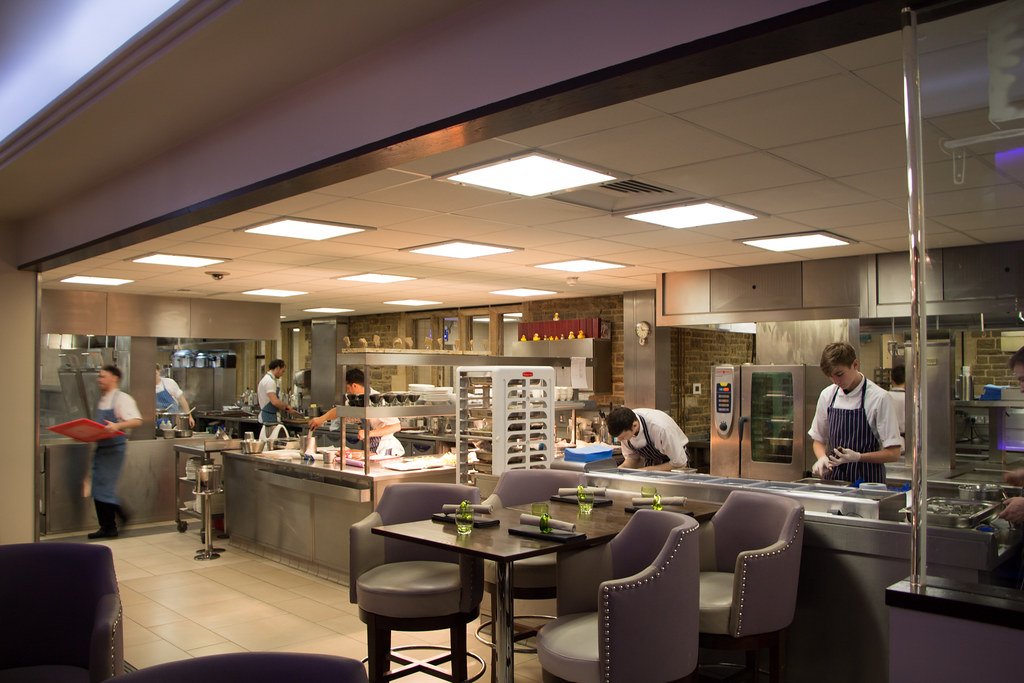
The open kitchen layout removes the physical barrier between the kitchen and the dining room, making the kitchen — or a portion of it — visible to guests. This design is as much a hospitality and marketing decision as it is a functional one.
How it works: Cooking stations (often a wood-fire grill, sushi bar, or pizza oven) are positioned where guests can watch food being prepared. The “back” kitchen handles prep and dishwashing out of sight, while the “show” kitchen handles final cooking and plating.
Best for:
- Upscale casual and fine dining restaurants
- Concepts built around culinary theater (sushi, teppanyaki, artisan pizza)
- Farm-to-table and transparency-focused brands
- Restaurants where chef personality is part of the brand
Advantages: Creates entertainment value and trust, allows chefs to interact with guests, can reinforce quality and freshness messaging, visually differentiating.
Disadvantages: Noise and smell management becomes critical, requires immaculate kitchen discipline at all times, higher standards for equipment aesthetics, more expensive to build and maintain.
How to Choose the Right Layout for Your Restaurant
Matching layout to restaurant type is critical. Use this decision table as your starting point:
| Restaurant Type | Recommended Layout | Why |
|---|---|---|
| Fast food / QSR | Assembly Line | Speed and consistency above all; limited menu makes linear flow optimal |
| Fast-casual | Assembly Line or Zone | Moderate menu complexity; needs speed with some customization flexibility |
| Casual dining | Zone/Station | Diverse menu requires specialized stations; table-service pacing allows it |
| Fine dining | Zone/Station or Island | Complex dishes need specialization; island layout enables chef oversight |
| Café / bakery | Galley or Zone | Often space-constrained; galley maximizes small footprints |
| Hotel / banquet | Island or Zone | Large volumes with multiple concurrent event types |
| Ghost kitchen | Assembly Line or Zone | Delivery-optimized; speed and accuracy over presentation |
| Chef-driven concept | Open Kitchen or Island | Culinary theater reinforces brand; chef visibility is part of the experience |
Your restaurant POS system should also integrate with your kitchen layout — specifically where your Kitchen Display System (KDS) screens are placed and how orders flow from the front-of-house to each station.
Essential Workflow Zones in Any Commercial Kitchen
Regardless of which layout you choose, every commercial kitchen must include these core functional zones:
- Receiving Zone: Loading dock or back entrance where deliveries arrive. Should be near storage and away from prep areas to minimize cross-contamination.
- Dry Storage: Shelved area for non-perishables. Ideally 50–75 sq ft minimum; temperature-controlled and well-ventilated.
- Cold Storage: Walk-in coolers and/or reach-in refrigerators. Position near prep areas to minimize travel time.
- Prep Zone: Where raw ingredients are cleaned, cut, portioned, and prepped for cooking. Needs ample counter space, sinks, and close access to storage.
- Cooking Zone: The heart of the kitchen — ranges, fryers, ovens, grills, steamers. Requires proper ventilation (hood system) above all cooking equipment.
- Plating/Expediting Zone: Where finished dishes are assembled and quality-checked before going to the floor. The expediter manages this zone.
- Service/Pass Zone: The handoff point between kitchen and front-of-house staff. Heat lamps keep dishes warm during the handoff.
- Dishwashing Zone: Should be separate from food prep areas, with its own sink bay and dishwasher. Position to minimize traffic through prep areas.
- Waste/Recycling Zone: Designated area for trash, compost, and recycling. Should have direct access to exterior for sanitation efficiency.
Commercial Kitchen Size Guidelines by Seating Capacity
How much kitchen space do you actually need? Industry guidelines suggest the kitchen should represent roughly 30–40% of total restaurant space. Here are typical size guidelines by seating capacity:
| Seating Capacity | Recommended Kitchen Size | Total Restaurant Size (Estimate) |
|---|---|---|
| Under 50 seats | 200–400 sq ft | 600–1,200 sq ft |
| 50–100 seats | 400–700 sq ft | 1,200–2,500 sq ft |
| 100–150 seats | 700–1,000 sq ft | 2,500–3,500 sq ft |
| 150–200 seats | 1,000–1,500 sq ft | 3,500–5,000 sq ft |
| 200+ seats | 1,500–2,500+ sq ft | 5,000+ sq ft |
Note: QSRs and delivery-only concepts may allocate more space to the kitchen (40–60% of total) since front-of-house space is reduced. Fine dining typically has larger dining rooms relative to kitchen size.
Common Kitchen Layout Mistakes to Avoid
Even experienced restaurant owners make preventable layout mistakes. Here are the most common ones and how to avoid them:
- Underestimating storage space: Most first-time operators don’t plan enough dry and cold storage. A good rule: double your initial storage estimate. You’ll use it.
- Poor placement of the dishwashing area: A dishwashing station placed in the middle of foot traffic creates constant congestion. It should be at the back or side, with its own clear path.
- Ignoring health code requirements: Every state and municipality has specific commercial kitchen requirements — minimum sink counts, hand-washing station locations, floor drain placement, ventilation specs. Get a copy of your local health code before designing anything.
- Wrong ventilation hood sizing: Your hood system must extend 6 inches beyond all cooking equipment on all sides and have adequate CFM (cubic feet per minute) for your equipment load. Undersized hoods fail inspections and create fire hazards.
- Cross-contamination flow: Raw meat storage should never be near ready-to-eat food prep. Receiving should not run through the prep kitchen. Design traffic flows to prevent raw and cooked foods from crossing paths.
- Not planning for ADA compliance: If your kitchen employs or may employ staff with disabilities, ensure pathways and workstations meet ADA requirements.
- Ignoring future growth: Build in the ability to add equipment as your menu or volume grows. Don’t paint yourself into a corner with no electrical capacity or plumbing stubs.
How to Plan Your Restaurant Kitchen Layout
Ready to start planning? Here’s a step-by-step approach:
- Define your menu concept first. Your menu determines your equipment, which determines your layout. Don’t design the space before you know what you’re cooking.
- List all required equipment. Create a complete equipment list with dimensions. Use our restaurant kitchen equipment list as a starting point.
- Map the workflow. Draw the journey of a dish from delivery through prep, cooking, plating, and service. Your layout should follow this natural flow.
- Choose your layout type. Use the decision table above to identify the best layout for your concept.
- Use planning tools. Free tools like AutoCAD (student version), SmartDraw, or even Google Slides can help you create scaled floor plans. Professional kitchen designers often use CAD software or specialized tools like Revit.
- Consult a kitchen designer. For kitchens over $100,000 in equipment, hiring a Certified Food Service Professional (CFSP) or a commercial kitchen designer typically pays for itself in efficiency gains and avoided mistakes.
- Get health department pre-approval. Many jurisdictions allow (and some require) plan review before construction. Submit your layout for review early to avoid costly changes.
- Plan your utilities. Confirm gas line capacity, electrical service amperage, water supply, and drain locations before finalizing equipment placement.
Frequently Asked Questions
What is the most common restaurant kitchen layout?
The zone/station layout is the most common for full-service restaurants because it accommodates diverse menus and allows staff specialization. Assembly line layouts are most common in QSR and fast-casual concepts where speed and consistency are paramount.
How much space does a commercial kitchen need?
A commercial kitchen should typically be 30–40% of your total restaurant footprint. For a 100-seat restaurant in 3,000 sq ft of total space, that’s approximately 900–1,200 sq ft of kitchen. Very small cafés can operate with as little as 200–300 sq ft if designed efficiently.
What is the minimum size for a commercial restaurant kitchen?
There’s no universal minimum, but practically speaking, most commercial kitchens need at least 150–200 sq ft to meet health code requirements for equipment spacing, ventilation, and separate prep/cooking areas. Many jurisdictions have specific requirements — check with your local health department before planning.
Can I change my kitchen layout after opening?
Yes, but it’s expensive. Moving plumbing (floor drains, sinks), gas lines, or ventilation hoods typically costs $5,000–$25,000+ depending on complexity. Small changes like repositioning prep tables or adding shelving are inexpensive. Design it right the first time and you’ll save significantly in the long run.