
Disclosure: RestaurantLaunchpad is reader-supported. When you purchase through links on our site, we may earn an affiliate commission at no additional cost to you. Read our editorial policy.
By Marcus Rivera | May 31, 2026 | How We Evaluate
Quick Answer: Starting a restaurant catering business typically requires $5,000–$25,000 in initial investment for equipment and licensing, and can add $50,000–$200,000 in annual revenue to an existing restaurant.
You’ve built a restaurant. Your kitchen runs efficiently, your team knows how to execute under pressure, and your food is genuinely good. Now imagine using all of that to generate a new revenue stream that doesn’t require more tables, more waitstaff, or longer hours.
That’s the promise of a restaurant catering business — and for thousands of restaurants across the U.S., it’s a promise that delivers. Whether you’re catering corporate lunches, wedding receptions, or private parties, adding catering to your restaurant can significantly boost your bottom line without the overhead of a second location.
This guide walks you through every step: from defining your model to closing your first catering contract.
What Is a Restaurant Catering Business?
A restaurant catering business is an extension of your existing restaurant operation that prepares and serves food at off-site locations — or hosts large groups at your venue. It’s different from standalone catering companies in one critical way: you already have the kitchen, the staff, the supplier relationships, and the brand.
That head start is enormous. A standalone caterer has to build everything from scratch. You’re leveraging infrastructure you’ve already paid for.
Restaurant catering typically falls into two categories:
- On-premise catering: Private dining rooms, buyouts, and large-party events held at your restaurant
- Off-premise catering: You transport and serve food at a client’s chosen location — offices, event halls, homes, outdoor venues
Both are valid. Many restaurants do both. The key is knowing which model fits your kitchen capacity, staff bandwidth, and target market.
Why Add Catering to Your Restaurant?
The financial case is compelling. According to industry estimates, the U.S. catering market exceeds $60 billion annually, with corporate catering representing the fastest-growing segment. Restaurants that add catering services report that it can account for 20–35% of total revenue within two years of launch.
Beyond raw revenue, catering offers something your dining room can’t: predictability. A catering contract means you know exactly how many guests you’re feeding, what they’re eating, and what you’re getting paid — days or weeks in advance. That kind of certainty is rare in the restaurant industry.
Understanding your profit margins is essential before you launch. Catering typically runs higher margins than dine-in service because you control portion sizes precisely, reduce waste, and charge for service labor explicitly.
Other benefits include:
- Keeps kitchen staff employed during slow dining periods
- Builds brand awareness in new markets and venues
- Creates relationships with corporate clients who become repeat customers
- Provides income during seasonal slowdowns
- Can be scaled up or down based on capacity
Step 1: Define Your Catering Model
Before you invest in equipment or apply for permits, decide what kind of catering operation you want to run. Your model determines your costs, your staffing needs, and your pricing structure.
Drop-Off Catering
You prepare food in your kitchen and deliver it in disposable containers. No staff stays on-site. This is the lowest-overhead model — great for corporate lunches and casual events. Margins are good, but you compete on price and convenience.
Buffet/Self-Service Catering
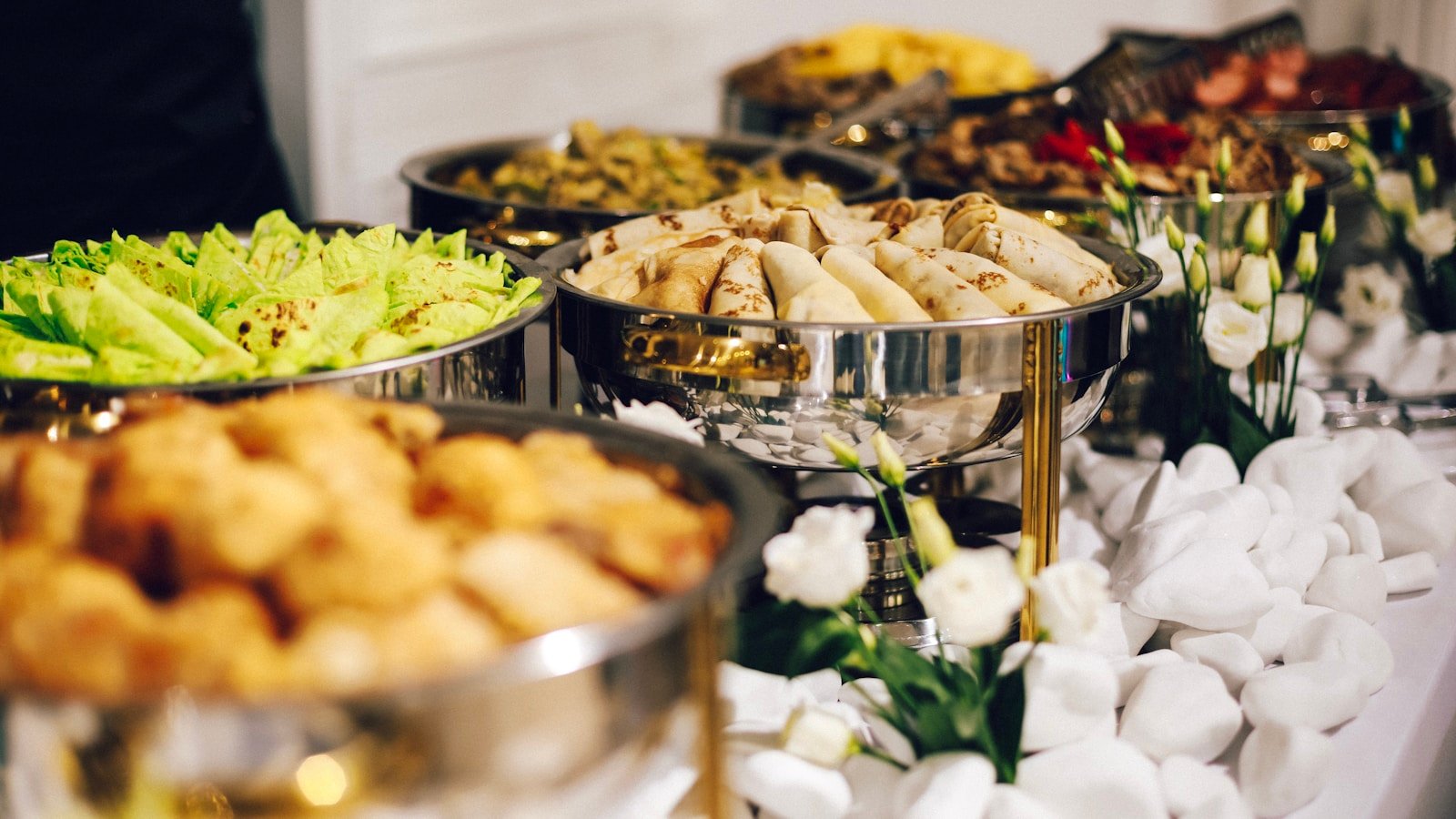
You set up chafing dishes, serving equipment, and food stations. A small crew manages setup and breakdown but doesn’t serve guests directly. Popular for office events, casual receptions, and company picnics.
Full-Service Catering
Your team handles everything: setup, plated service, drinks, and breakdown. This is the highest-revenue, highest-cost model. It’s appropriate for weddings, galas, and corporate dinners where presentation matters.
On-Premise Private Events
Host large groups in your restaurant for buyouts or private dining room events. Lower logistics complexity since everything happens in your kitchen and dining space. Great entry point for restaurants just starting to explore catering.
Most successful restaurant catering operations start with drop-off or buffet service, then expand into full-service once they’ve built systems and staff capability. If you’re just starting a restaurant or adding catering early, keep the model simple.
Step 2: Legal Requirements and Licensing
This is the step many restaurant owners underestimate. Your existing restaurant license does not automatically cover off-premise catering in most states. You’ll likely need additional permits and approvals.
Catering License or Endorsement
Most states require a separate catering license or an endorsement added to your existing food service license. Requirements vary significantly by state. Contact your local health department before assuming your current license covers catering.
Temporary Food Permits
For off-site events, many jurisdictions require a temporary food establishment permit for each event, or a blanket permit for recurring events. Some require advance notice (24–72 hours). Budget for this in your pricing.
Alcohol Licensing
If you plan to serve alcohol at catering events, you’ll need a catering or banquet liquor license in addition to your restaurant license. These are often separate applications with their own fees and requirements.
Health Code Compliance
Off-premise catering has strict temperature control requirements. Food must be transported and held at safe temperatures (hot food above 140°F, cold food below 40°F). You’ll need insulated transport containers, chafing dishes with fuel, and temperature logs.
Insurance
Your restaurant’s general liability policy likely does not cover off-site catering events. Review your coverage carefully — your catering insurance needs should include:
- General liability for off-site events
- Liquor liability (if serving alcohol)
- Commercial auto (for delivery vehicles)
- Workers’ compensation for catering staff
- Product liability for food-related claims
Step 3: Equipment Needed for Catering
Your restaurant kitchen can handle prep and cooking. What you’ll need to invest in is transport and serving equipment. The good news: this is the primary equipment expense, and it’s far less than opening a new kitchen.
Transport Equipment
- Insulated food carriers: Cambro or Carlisle carriers maintain temperature for 4+ hours. Budget $100–$300 each.
- Sheet pan carriers: Transport full sheet pans without spilling. Essential for bakery or large-batch items.
- Insulated beverage carriers: For coffee, lemonade, or water service.
- Delivery vehicle: If you don’t have one, factor in leasing or purchasing a van. Some operators use third-party delivery services for smaller events.
Serving Equipment
- Chafing dishes: Standard equipment for buffet service. Buy full-size (8 qt) and half-size. Budget $50–$150 each; you’ll need 6–12 to start.
- Serving utensils: Tongs, ladles, spoons in multiple sizes.
- Serving platters and bowls: For cold items and appetizers.
- Folding tables and linens: If clients don’t provide them.
- Sterno or electric chafing fuel: Keep a consistent supply.
Total Equipment Budget
A basic catering setup for events up to 100 guests typically runs $3,000–$8,000. This is the core of your initial startup costs for the catering operation.
Step 4: Build Your Catering Menu
Your catering menu should not be a copy of your restaurant menu. It should be a curated selection of items that:
- Travel and hold well (no items that deteriorate in 30 minutes)
- Can be produced in large quantities without quality loss
- Use ingredients you already stock
- Can be prepped in advance
- Are easy to serve in a buffet or plated format
Menu Structure for Catering
Organize your catering menu into packages rather than à la carte items. Packages simplify ordering for clients and help you control food costs:
- Bronze Package: Includes 1 protein, 2 sides, bread, non-alcoholic beverages
- Silver Package: 2 proteins, 3 sides, salad, bread, dessert, beverages
- Gold Package: Full-service dinner with appetizers, 2 proteins, 4 sides, salad, dessert, staff service, linen
Offer customization within packages — let clients swap proteins or add dietary accommodations. This builds perceived value while keeping your kitchen operations predictable.
Items That Work Well for Catering
- Braised meats (beef short ribs, pulled pork, chicken thighs)
- Grain-based dishes (rice pilaf, quinoa salad, pasta)
- Roasted vegetables
- Composed salads (dressed at service)
- Individual desserts (brownies, cookies, mini cheesecakes)
Step 5: Pricing Strategy
Catering pricing is more complex than restaurant pricing. You’re not just covering food costs — you’re covering transport, staffing, equipment, permits, and event overhead.
The Catering Pricing Formula
| Cost Component | Typical % of Price | Notes |
|---|---|---|
| Food Cost | 25–30% | Same target as restaurant food cost |
| Labor | 25–35% | Includes kitchen prep, transport, service |
| Equipment/Supplies | 5–10% | Disposables, fuel, linen |
| Overhead | 10–15% | Insurance, permits, vehicle costs |
| Profit Margin | 15–25% | Target for sustainable operation |
Per-Person Pricing Benchmarks (2026)
- Drop-off lunch: $12–$25 per person
- Buffet service: $25–$55 per person
- Full-service dinner: $65–$150+ per person
- Minimum order: Most caterers set minimums of $500–$1,500 per event
Always include a service fee (typically 18–22%) on top of per-person pricing to cover staffing and logistics. Be transparent about this in your contracts.
Step 6: Marketing Your Catering Services
Your restaurant’s existing reputation is your best marketing asset. But catering clients don’t always overlap with your dining guests — you need to reach them where they are.
Corporate Catering
Corporate clients are the holy grail of catering: high volume, repeat business, predictable scheduling. To reach them:
- Identify companies within 5–10 miles of your restaurant
- Visit HR departments or office managers with a catering menu and sample box
- List your business on platforms like ezCater, Cater2.me, and Fooda
- Offer a “lunch trial” at a discounted rate for first-time corporate clients
- Network with local business associations and chambers of commerce
Wedding and Event Catering
- Partner with local event venues, wedding planners, and photographers
- List on The Knot, WeddingWire, and local event directories
- Host tasting events at your restaurant for prospective clients
- Build a portfolio of event photos for your website and social media
Digital Marketing
- Add a dedicated catering page to your restaurant website with packages and contact form
- Create a Google Business profile category that includes catering
- Run targeted ads on Facebook and Instagram for local event planners and HR professionals
- Collect reviews specifically for catering events on Google and Yelp
Step 7: Staffing for Catering Events
Catering staffing is one of the most common failure points for new restaurant caterers. You need enough people — but not so many that you eat your margin.
Standard Staffing Ratios
- Drop-off delivery: 1 driver (possibly you)
- Buffet up to 75 guests: 1 setup/breakdown + 1 runner
- Buffet 75–150 guests: 2 setup + 1 runner + 1 supervisor
- Full-service up to 100 guests: 1 server per 15–20 guests + 1 supervisor
Where to Find Catering Staff
- Use your existing restaurant staff (schedule them for catering shifts in advance)
- Build a roster of on-call part-time staff from culinary schools
- Use temp staffing agencies for large events
- Train one or two employees as catering supervisors who manage each event independently
Pay catering staff at least $2–$3 more per hour than regular restaurant rates — catering events are physically demanding and often require early morning or evening hours.
Step 8: Managing Catering Logistics
Logistics is where catering businesses succeed or fail. A great meal ruined by cold food, late arrival, or missing equipment destroys your reputation. Build systems before you take your first event.
The Catering Contract
Every catering event needs a signed contract that covers:
- Event date, time, location, and guest count
- Menu and package details
- Total price, payment schedule, and deposit amount (typically 25–50%)
- Cancellation and refund policy
- Final guest count deadline (usually 72 hours before event)
- Client responsibilities (parking, kitchen access, tables if applicable)
- Liability clauses
Day-of Checklist
- Confirm all food is prepped and at correct temperatures
- Load vehicle in reverse order of need (last-needed items first)
- Verify all equipment is packed (chafing dishes, fuel, utensils, linen)
- Confirm address and parking with client
- Bring temperature log and food safety kit
- Assign roles to each staff member before departure
- Set up 30–45 minutes before service start
Post-Event Process
- Collect all equipment and dispose of food properly
- Send client a thank-you email with a review request
- Log actual food cost and labor hours vs. estimate
- Debrief with staff on what worked and what to improve
How to Fund Your Catering Launch
If you need capital for the initial equipment purchase, there are several paths. Your existing restaurant’s revenue history makes you a stronger loan candidate than a startup. Review your options for funding your catering operation, including SBA loans, equipment financing, or simply reinvesting slow-season profits.
Common Mistakes to Avoid
- Underpricing events: New caterers often forget to include labor, transport, and equipment depreciation in their pricing. Use the formula above every time.
- Overpromising staff availability: Don’t commit to three events on the same day until you have staff systems in place.
- Ignoring permits: Operating without proper catering permits can result in fines and license suspension. Check your local requirements before your first event.
- Menu that’s too complex: Keep your catering menu tighter than your restaurant menu. Complexity kills consistency at scale.
- No deposit policy: Always collect a deposit. Last-minute cancellations without deposits can leave you covering food and labor costs with no revenue.
- Skipping the contract: Verbal agreements lead to disputes. Every event needs a signed contract.
- Ignoring food safety: Temperature violations at catering events can cause foodborne illness. Take food safety training seriously and document your temperature logs.
Frequently Asked Questions
Do I need a separate catering license if I already have a restaurant license?
In most states, yes. Your restaurant license covers food service at your fixed location. Off-premise catering typically requires an additional endorsement or separate license. Check with your state and local health department before operating.
How much money can a restaurant make from catering?
It varies significantly by market and event type, but restaurants with active catering programs commonly report $50,000–$200,000 in additional annual catering revenue. Corporate catering contracts (especially recurring lunch programs) can generate $2,000–$10,000 per month from a single client.
What’s the minimum investment to start catering?
If you already have a functioning restaurant kitchen, you can launch catering for $5,000–$15,000, covering basic transport containers, chafing equipment, permits, insurance updates, and initial marketing. Full-service catering with a dedicated vehicle runs higher.
Should I hire a catering coordinator?
Once you’re handling more than 4–6 events per month, a dedicated catering coordinator pays for itself. They manage client inquiries, contracts, staffing, and logistics — freeing you to focus on the restaurant. Consider this hire when catering revenue exceeds $10,000/month.
Can I cater events that conflict with restaurant service hours?
Yes, with planning. Many restaurants prep catering orders during morning prep hours before lunch service. Off-site events typically happen during times your dining room is slower (weekday lunches, weekend events when your restaurant may be closed). This is part of what makes catering so attractive — it fills your kitchen’s idle time.